Wireless charging lets you power up your phone by simply placing it on a pad — no cables, no fumbling for the right connector. But how does wireless charging work? The answer comes down to a piece of physics that’s over 100 years old: electromagnetic induction. Here’s a plain-English breakdown.
What Is Wireless Charging? Wireless charging is a way to transfer power from a charging pad to your device without a physical cable. Instead of electricity flowing through a wire, it travels through a magnetic field created between two coils — one in the charger, one in your phone. As long as the two are close enough, energy moves across the small gap between them.
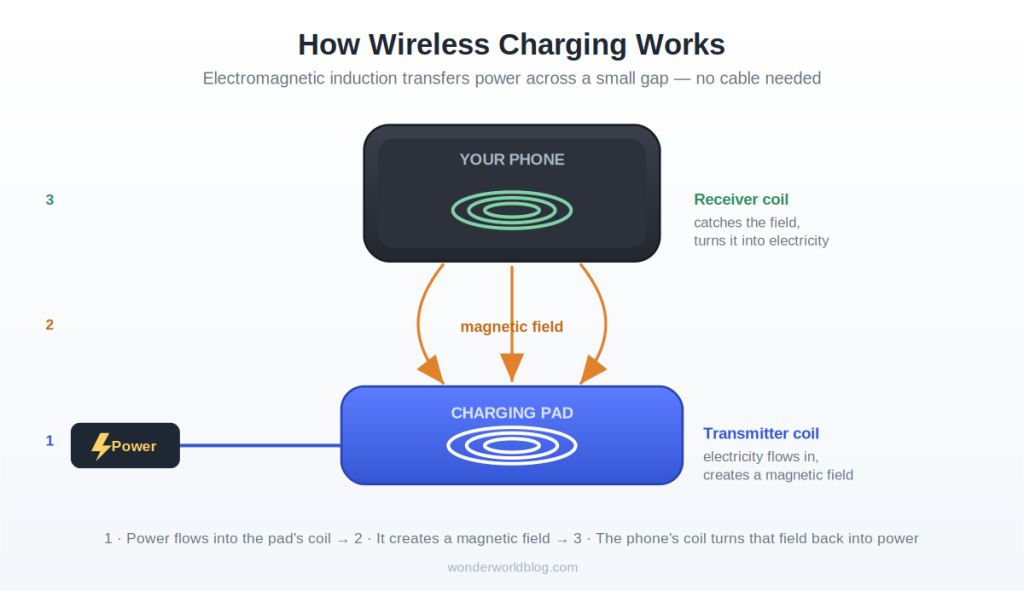
How Does It Actually Work? (Electromagnetic Induction Explained) The core principle is called electromagnetic induction. It works like this: the charging pad contains a coil of wire. When electricity runs through that coil, it creates a magnetic field around it. Your phone has its own coil. When you place the phone on the pad, that magnetic field passes through the phone’s coil and generates an electric current inside it. That current is what charges your battery.
Think of it like two tuning forks. Strike one, and a nearby fork starts vibrating on its own — no contact needed. Wireless charging does the same thing, but with magnetic energy instead of sound.
The Key Parts: Transmitter and Receiver Coils Every wireless charging setup has two main parts:
- The transmitter coil sits inside the charging pad. It generates the magnetic field.
- The receiver coil sits inside your phone. It catches the magnetic field and converts it back into electricity.
For charging to work, these two coils need to be aligned and close together — usually within a few millimeters. That’s why your phone has to sit in a specific spot on the pad, and why charging can stop if you nudge it out of place.
Wireless Charging Standards: What Is Qi? Most phones today use a standard called Qi (pronounced “chee”). A standard is just an agreed-upon set of rules that makes sure chargers and phones from different brands can work together. Because of Qi, you can usually charge a Samsung phone on a charger made for an iPhone, and vice versa. There are other standards, but Qi is by far the most common.
Does Wireless Charging Work Through a Phone Case? In most cases, yes. Thin plastic, silicone, or rubber cases won’t block the magnetic field. However, thick cases — especially ones with metal plates (like some magnetic mounts) or built-in batteries — can interrupt charging or stop it completely. A good rule of thumb: if your case is under about 3mm thick and has no metal, wireless charging should work fine.
The Downsides: Is Wireless Charging Slower? Wireless charging is convenient, but it has trade-offs. It’s usually slower than plugging in a cable, because some energy is lost as heat during the transfer. It also generates more heat overall, which over a long time can be slightly harder on your battery. And you can’t really use your phone comfortably while it’s charging, since it has to stay flat on the pad. From my own experience, wireless charging is mostly about adding convenience to our daily routines. However, you can sometimes run into alignment issues where the phone doesn’t connect properly, which significantly impacts the actual charging efficiency.Ultimately, much like the dynamic between wireless Bluetooth earbuds and classic wired headphones, both charging methods serve their own unique purposes and are absolutely indispensable.
Is Wireless Charging Worth It? For most people, wireless charging is about convenience, not speed. If you want the fastest possible charge, a cable still wins. But if you like the simplicity of dropping your phone on a pad at your desk or bedside, it’s a small luxury that’s hard to give up.
