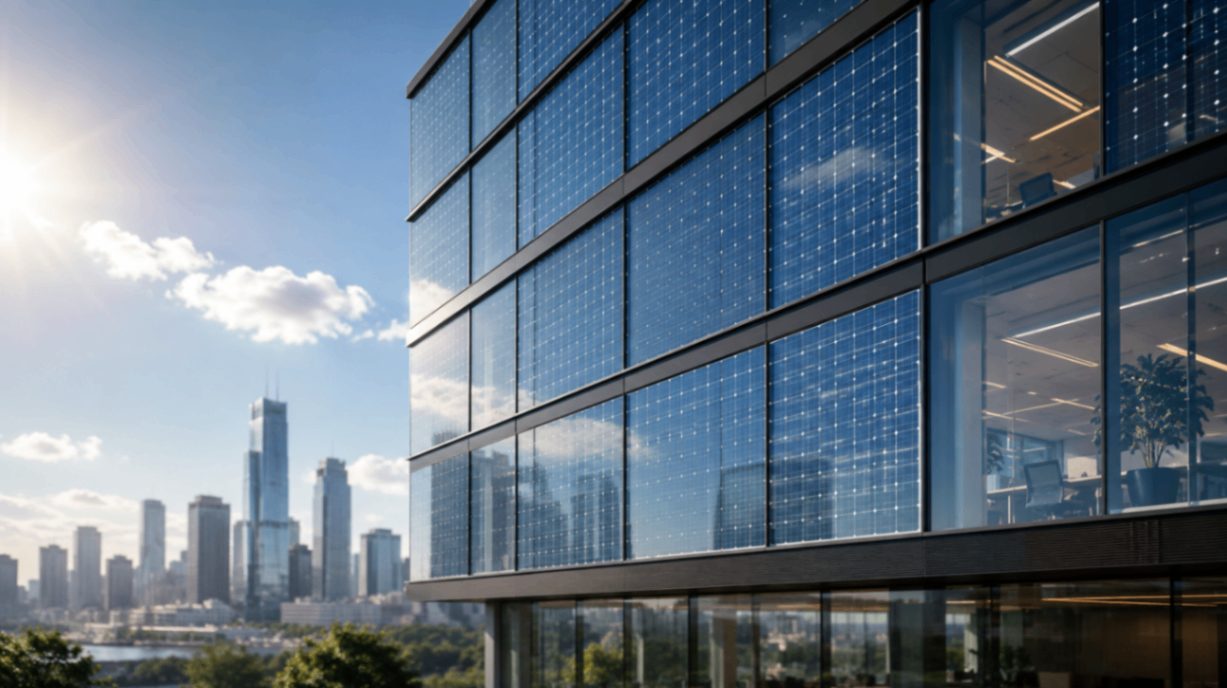
How Do Solar Windows Work?
Imagine an office window that lets you see outside while quietly generating electricity from sunlight.
That is the idea behind solar windows. Also known as transparent solar panels or photovoltaic glass, these windows contain materials that convert sunlight into electrical energy.
Unlike conventional solar panels, solar windows are designed to remain partly or almost completely transparent. This means they could eventually be installed in homes, offices, skyscrapers, greenhouses and even vehicles.
But how can a transparent piece of glass generate electricity?
What Are Solar Windows?
Solar windows are glass panels that contain photovoltaic materials.
Photovoltaic materials absorb energy from sunlight and use it to create an electrical current. The same basic process happens inside traditional rooftop solar panels.
The main difference is transparency.
Ordinary solar panels are dark because they absorb a large amount of sunlight. Windows, however, must allow enough visible light to pass through for people to see outside.
Solar-window developers must therefore balance two competing goals:
- Generating electricity
- Maintaining transparency
Some solar windows are nearly clear, while others look slightly tinted. Semitransparent versions may be used in skylights, building facades or places where completely clear glass is not necessary.
How Do Solar Windows Generate Electricity?
Sunlight contains more than the visible colors humans can see. It also includes ultraviolet and infrared wavelengths.
Some transparent solar technologies allow most visible light to pass through while absorbing ultraviolet or infrared energy. Other designs absorb part of the visible light, which makes the glass appear tinted.
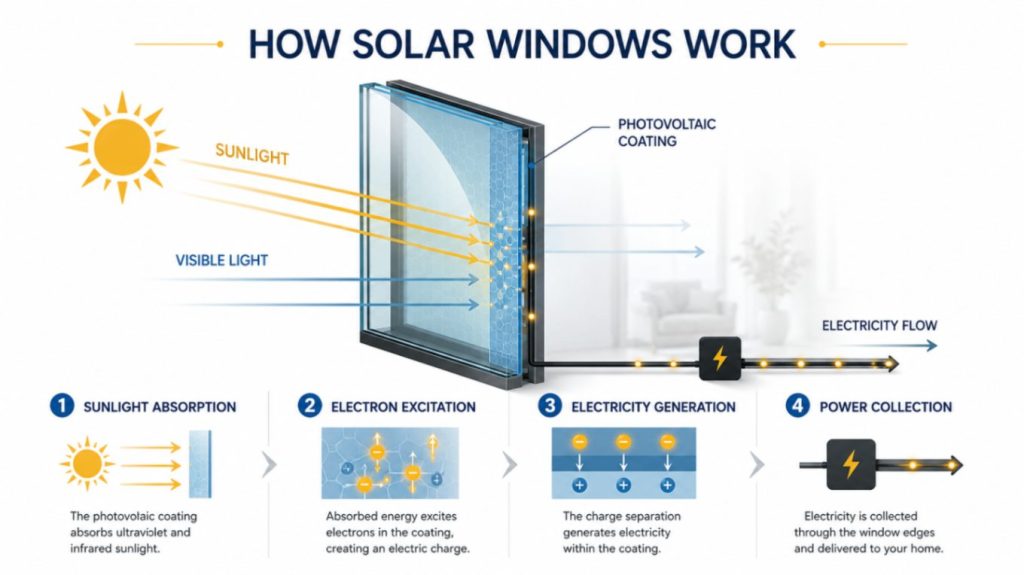
The process usually involves four steps.
1. Sunlight Reaches the Window
Sunlight strikes a thin photovoltaic layer inside or on the surface of the glass.
2. The Solar Material Absorbs Energy
The photovoltaic material captures selected wavelengths of sunlight.
Depending on the technology, it may absorb visible light, ultraviolet light, infrared light or a combination of them.
3. Electrons Begin to Move
The absorbed solar energy excites electrons inside the material. Their movement creates an electrical current.
4. Electricity Is Collected
Transparent conductive materials carry the current toward the edge of the window. Wiring can then send the electricity to a battery or the building’s electrical system.
To someone inside the building, the window may look almost normal. Behind the glass, however, it is operating like a small solar power generator.
What Are Solar Windows Made Of?
Several types of photovoltaic materials can be used to create solar glass.
Organic Solar Cells
Organic solar cells use carbon-based materials to absorb sunlight.
They can be lightweight, flexible and manufactured in different colors. These characteristics make them suitable for windows and curved architectural surfaces.
However, researchers are still working to improve their efficiency and long-term durability.
Perovskite Solar Cells
Perovskites are materials that can absorb sunlight efficiently, even when applied in very thin layers.
Their transparency and color can be adjusted, making them promising for solar-window applications. The main challenge is ensuring that they remain stable after years of exposure to heat, moisture and sunlight.
Thin-Film Solar Cells
Thin-film solar cells are made by depositing thin layers of photovoltaic material onto glass.
Many thin-film products are semitransparent rather than completely clear. They can be used in skylights, canopies and building facades where some shading is acceptable.
Why Could Solar Windows Be Useful?
The greatest advantage of solar windows is the amount of unused surface area they could turn into energy-generating space.
More Space for Solar Energy
A tall building may have limited rooftop space but thousands of square meters of windows.
Covering part of that glass area with solar technology could help the building generate additional electricity without requiring more land.
Power Produced Where It Is Used
Solar windows could generate electricity directly in homes, offices and commercial buildings.
The energy might help power lighting, ventilation systems, sensors or other equipment used during the day.
Reduced Indoor Heat
Tinted or semitransparent solar glass can absorb some of the sunlight that would otherwise enter a building as heat.
This could reduce the amount of energy needed for air conditioning, particularly in buildings with large glass facades.
Better Architectural Integration
Traditional solar panels are normally added to a building after its basic structure has been designed.
Solar glass could become part of the building itself, replacing ordinary windows, skylights or facade panels. This approach is often called building-integrated photovoltaics.
What Are the Limitations of Solar Windows?
Solar windows are promising, but several challenges still prevent them from becoming common.
Lower Efficiency
A traditional solar panel can absorb a large amount of sunlight because it does not need to be transparent.
A solar window must allow some light to pass through. As a result, highly transparent solar windows generally generate less electricity than opaque panels.
Higher Cost
Solar glass requires specialized coatings, materials, wiring and installation.
Although it may replace conventional building glass, its initial cost can still be significantly higher than that of an ordinary window.
Durability
Building windows are expected to last for decades.
Solar windows must survive sunlight, rain, moisture, cleaning, temperature changes and strong winds without losing their transparency or electrical performance.
Complex Installation
Each electricity-generating pane must be safely connected to the building’s electrical system.
Large buildings may contain hundreds or thousands of glass panels, making wiring, maintenance and replacement more complicated.
Can Solar Windows Power an Entire Building?
Solar windows are unlikely to replace conventional solar panels completely.
Vertical windows do not always receive sunlight at the best angle, and nearby buildings may create shadows. Transparent cells also tend to produce less electricity than rooftop panels.
A more practical future building might combine:
- Rooftop solar panels
- Solar windows
- Battery storage
- Smart glass
- Energy-efficient insulation
- Intelligent building controls
Solar windows would provide an additional source of energy rather than supplying all of the building’s electricity.
They may be especially valuable for skyscrapers and commercial buildings that have large glass facades but limited rooftop space.
Where Could Solar Windows Be Used?
Solar glass could eventually appear in many different places.
Offices and Skyscrapers
Large glass buildings could use sections of their facades to generate electricity.
Homes
Residential solar windows might help power lights, smart-home devices or ventilation systems.
Greenhouses
Semitransparent solar panels could generate electricity while allowing enough light to reach plants.
Cars and Public Transportation
Solar glass could be integrated into sunroofs, panoramic roofs, buses and trains to provide additional energy for onboard electronics.
Skylights and Canopies
These may become some of the earliest common applications because slightly tinted glass is often acceptable in these locations.
When Will Solar Windows Become Common?
Some types of photovoltaic glass are already used in specialized architectural projects. However, affordable and highly transparent solar windows are not yet standard products for ordinary homes.
Before widespread adoption, manufacturers must improve:
- Energy efficiency
- Transparency
- Manufacturing cost
- Long-term durability
- Installation methods
Semitransparent skylights, commercial facades and architectural glass are likely to become more common before completely clear household solar windows.
The Future of Energy-Generating Glass
Windows have traditionally been passive parts of a building. They provide light, views and protection from the weather but do not produce energy.
Solar technology could change that.
Future windows may generate electricity, reduce indoor heat and automatically control how much light enters a room.
Solar windows will probably not replace rooftop panels. However, they could transform millions of unused glass surfaces into additional sources of clean energy.
One day, the window beside you may do more than let sunlight into the room.
It may also turn that sunlight into electricity.
Frequently Asked Questions
Are solar windows completely transparent?
Some experimental solar windows are nearly transparent, but many current designs are tinted or semitransparent. Greater transparency usually means less electricity generation.
Are solar windows as efficient as solar panels?
Generally, no. Traditional solar panels can absorb more sunlight because they do not need to remain transparent.
Do solar windows work on cloudy days?
Yes. They can generate electricity from indirect daylight, although their output will usually be lower than in direct sunlight.
Can solar windows replace normal windows?
Some photovoltaic glass products can be used as windows, skylights or building facades. Their suitability depends on cost, transparency, insulation and local building requirements.
